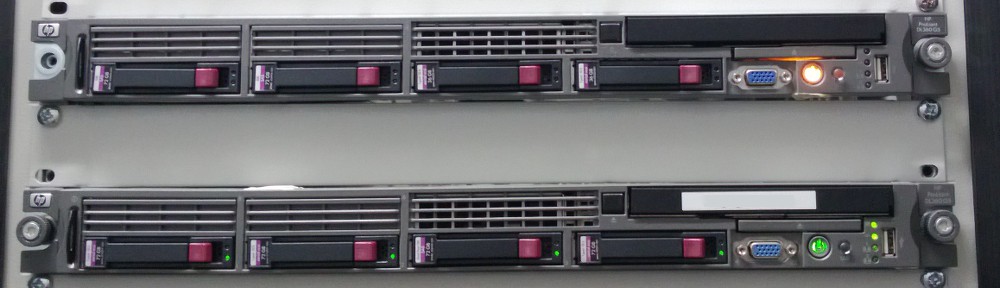

Yeah, finally, my two Pis have arrived, and the housing from RS fits nicely. So, what’s next? Anyone benchmarked a Pi to a SheevaPlug as OpenVPN gateway yet? XBMC is another thing I keep reading the Pi shall be suited for? Question is if the Pi optimized version is already PVR capable, i. e. supports VDR as the DVB backend … Yeah, time for the holiday season to arrive :-)
Source: wusel’s Space (sent via email)
I’ve heard differing opinions about its multi-media capabilities. On one hand one person said it handles everything fine (not just the natively-handled 1080p which the GPU can do by itself, but also other resolutions which require main-CPU scaling) but another person said the opposite (which I was more expecting – the main CPU is not that powerful).
My experiences with it based on some basic tests using OpenCV to capture and display frames were that VGA coming from a USB webcam pegged the CPU completely and displayed at roughly 1 frame per 2 seconds. 320×240 captured and displayed at around 5-10 fps. I don’t think there are any easy mechanisms for offloading general computation to the GPU, based on what I’ve read.
Also bear in mind that the ethernet port actually runs on the USB bus, so there are significant CPU overheads and bandwidth limitations.
Well, yeah; first of all, if you want to display video, it’s €2.95 for the MPEG-2 decoding key (and probably you’ll want to add the €1.47 for the VC-1 key as well). I don’t think the RPi will survive long without offloading MPEG-2 decoding (read: DVB streams); unfortunately, current OpenELEC builds don’t play with VDR at all :(
Speaking of Ethernet, that’s a very valid point I didn’t pay attention to before:
The SheevaPlug’s relatives use an on-SOC 10/100/1000 interface, IIRC connected via PCI-X or what they use nowadays. So, the relative advantage of having floating-point done in hardware is countered by moving any network traffic through the USB subsystem.