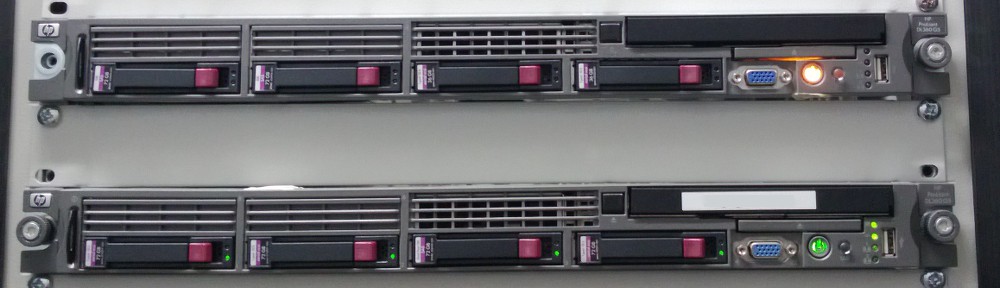
death, reanimated

(Blogged via flickr)

Neues Herz (Mainboard, CPU), neue Lunge (Netzteil), neue Installation – Fedora 7 ist nicht auf 12 updatebar (ich müßte erst auf mind. 10 hoch) und Neuinstallation per DVD ist ja wie berichtet auch no-go, ergo treibt jetzt ein kotzender Koala meinen Desktop. Jetzt muß ich noch Platten(inhalte) konsolidieren, auf daß auch die ollen Uraltplatten < 500 GB und/oder mit PATA wegkönnen.

Kamera: Motorola Milestone (f/2.8)

Technology …

Tja, das hätte ich besser vorher gelesen:

5.0 von 5 Sternen Einwandfrei auch mit Festplatten, 17. Oktober 2008
Von Passenger – Alle meine Rezensionen ansehen
Ich habe damit zwei Festplatten (160 und 300 GB) angeschlossen. Ging problemlos (wenn man die Platine richtig rum draufsteckt *hüstel* und auf Master jumpert).
Mitgeliefert wird alles, was man benötigt: ein SATA-Kabel und ein Adapter für den Stromanschluß.


4.0 von 5 Sternen Nicht ohne Fehler, 3. Februar 2009
Von M. Stelter – Alle meine Rezensionen ansehen
(REAL NAME)
– Qualität der Leiterplatte sehr gut
– Funktion nur gewährleistet, wenn Adapter nicht bis Anschlag in das IDE-Gerät gesteckt wird, da sonst Kurzschluss zwischen den Lötverbindungen auf der Rückseite der Leiterplatte und des Gehäuses (kein Schaden entstanden, Netzteil meist Kurzschlussfest bzw. schaltet ab
– nach dem Erkennen, dieses Problems und beheben duch Isolator bzw. durch nur leichtes Einstecken – funktioniert gewährleistet!
– Auf Grund dieses Fehlers bei der Kontruktion 4 Sterne. Erfüllt seinen Zwecke auf jeden Fall
Helfen Sie anderen Kunden bei der Suche nach den hilfreichsten Rezensionen

 
Ebenso hilfreich diese Bugbeschreibung: »Misqualifiziert« war die IDE-Platte mit IDE2SATA-Adapter am Mainboard-nVidia-SATA-Port auch. Und nicht nutzbar … Jetzt hängt sie am Promise TX2plus an einem der beiden ungenutzen SATA-Ports und … dient Ubuntus Komischem Koala als Bootplatte.

Fedora 12 #Mega #Fail :(

Tested ok, installation failed nonetheless …

(Blogged via flickr)

I really, really hate this. Well, it will be Ubuntu then, replacing my last Fedora installation …

Kamera: Motorola Milestone (f/2.8)

Warum trifft's immer mich?

(Blogged via flickr)

Notumbau des Desktops wg. Hardwareversagen von X2-Athlon auf seit längerem bereitliegende X4-Basis; Fedora 7 erkennt leider den ‘forceth’ nicht (jedenfalls gibts damit keinen Datenverkehr) und der Updateversuch von der Netinstall-CD ist ein tiefer Griff ins Klo (s. oben) *sigh* Mal ganz abgesehen davon, daß die extra für solche Aktionen bereitliegenden IDE-Platten-an-SATA-Port-Adapter vollumfänglich bei Platten wie auch DVD-ROM-LW versagt haben …

Kamera: Motorola Milestone (f/2.8)

He's dead, Jim.

(Blogged via flickr)

Hostname: death; der Name ist eigentlich nicht als Programm gedacht gewesen … Schade, klingt vor allem wieder nach Mainboard- und/oder Netzteil-Tod. Immerhin: kein C4 drin :)

Kamera: Motorola Milestone (f/2.8)

Mental note: if using UBI, better have UBI in your kernel

Alas, I tried to upgrade to – self-build – kernel 2.6.32.2 again, and bricked my SheevaPlug, again.
Fortunately, all info needed to boot from a working uImage off USB is available within uBoots environment variables:

Marvell>> usb start; fatload usb 0 0x00800000 uImage
(Re)start USB...
USB: scanning bus for devices... 2 USB Device(s) found
scanning bus for storage devices... 1 Storage Device(s) found
reading uImage
...
...
......................................................................................................................................................................................................................
...
2620504 bytes read
Marvell>> setenv bootargs $(bootargs_console) $(mtdpartitions) ubi.mtd=1 root=ubi0:rootfs rootfstype=ubifs ; bootm 0x00800000

This finally loaded the uImage (Sheeva’s version of good-old zImage) from the attached USB drive, provided the kernel command line with the (still working) in-flash root-fs and jumped to the kernel images as loaded into RAM. Cool stuff. Reason for this: UBI/UBIFS is not selected per default for the platform. Booting from an UBI device and an UBI-filesystem on it without the kernel even knowing how to spell UBI leads to the well-know panic() :-)

Linux version 2.6.32.2 (wusel@greebo) (gcc version 4.4.1 (Sourcery G++ Lite 2009q3-68) ) #2 PREEMPT Fri Dec 25 04:16:40 CET 2009

Cool stuff – short nights ;)

Safely bricking my SheevaPlug …

As I received my second SheevaPlug Development Kit yesterday, it was time to actually try flashing it; the first unit was ordered with an UBIFS installation from NewIT – which runs great! –, this time I saved the about 5 UKP and intended to try to convert the unit from jffs2 to ubifs myself. Given that there even exists a ready-to-run Installer, how difficult could that be?
Ah, well … To make the story short – it’s Christmas Eve after all –, I bricked it. On the first opportunity ;)
As it turned out, using an USB 2.0 2-GB-stick, off which the WD TV Live happily boots a Debian live system (courtesy of b-rad), didn’t go too well with the SheevaPlug: using the Installer stuff, I wiped the NAND, flashed a new uBoot and then SheevaPlug rebooted, trying to fetch kernel and rootfs from the attached USB stick. It tried. It resetted even USB, I think. Then it gave up with an “drive not ready”-message => now my SheevaPlug was stuck uBooting into failing to flash, great. At least I was able to witness this all live via “minicom -o /dev/ttyUSB0”, this being a development kit. Ah, and yes, even without a working uBoot I should be able to reflash uBoot through this JTAG-and-serial-via-USB connection; although I prefer not to need that …
Running out of options (that is: free USB sticks; it is said in the Forums that using an USB HDD might yield exactly this, that is a not ready drive at the time SheevaPlug wants to fetch the data), I pulled out the MicroSD-to-SD-adapter out of my Zi8, put the tiny 4-GB-MicroSD it contained into a USB-MicroFlash-adapter, wrote the Installer-data onto it, safely unmounted it, attached it to the USB host port of the SheevaPlug … and rebooted the SheevaPlug.
This time it worked as advertised: the NAND got erased, reprogrammed, the Plug rebootet, fetched kernel and rootfs from the USB device, flashed that, rebootet again – and I had my SheevaPlug the way I like (and need) it: booting really fast, having modules for all kinds of uses where they belong (as delivered, there was an empty /lib/modules/`uname -r` – so, no luck with an USB hub to start with); guys, this is really, really cool stuff! (Ok, not the Plug itself, mine at least get’s pretty hot even doing nothing.)
Instead of a former ~120 second boot cycle, I’m now down to …

dhcp-server:~# ssh root@plug-2 shutdown -r now \; exit ; rc=0; date ; while [ $rc -eq 0 ]; do ping -W 1 -c 1 plug-2 >/dev/null ; rc=$? ; done ; date ; rc=1; date ; while [ $rc -eq 1 ]; do ping -W 1 -c 1 plug-2 >/dev/null ; rc=$? ; done ; date
root@plug-2's password:
Thu Dec 24 10:59:54 CET 2009
Thu Dec 24 10:59:59 CET 2009
Thu Dec 24 11:00:25 CET 2009

… roughly 30 seconds from “shutdown” to “pinging again”. This rocks ;)
Merry Christmas!