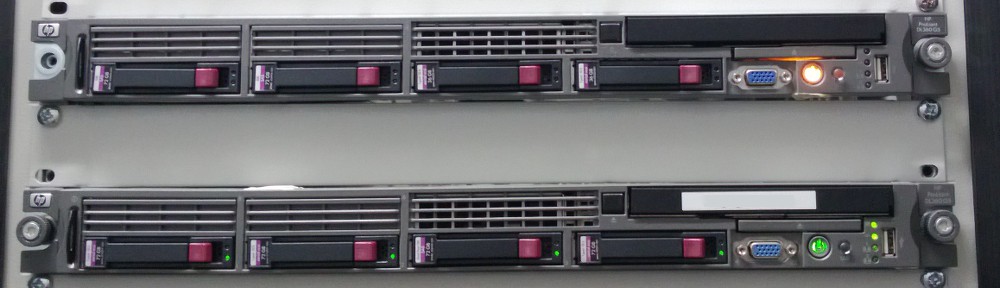
Notumbau des Desktops wg. Hardwareversagen von X2-Athlon auf seit längerem bereitliegende X4-Basis; Fedora 7 erkennt leider den ‘forceth’ nicht (jedenfalls gibts damit keinen Datenverkehr) und der Updateversuch von der Netinstall-CD ist ein tiefer Griff ins Klo (s. oben) *sigh* Mal ganz abgesehen davon, daß die extra für solche Aktionen bereitliegenden IDE-Platten-an-SATA-Port-Adapter vollumfänglich bei Platten wie auch DVD-ROM-LW versagt haben …
He's dead, Jim.
Mental note: if using UBI, better have UBI in your kernel
Alas, I tried to upgrade to – self-build – kernel 2.6.32.2 again, and bricked my SheevaPlug, again.
Fortunately, all info needed to boot from a working uImage off USB is available within uBoots environment variables:
Marvell>> usb start; fatload usb 0 0x00800000 uImage (Re)start USB... USB: scanning bus for devices... 2 USB Device(s) found scanning bus for storage devices... 1 Storage Device(s) found reading uImage ... ... ...................................................................................................................................................................................................................... ... 2620504 bytes read Marvell>> setenv bootargs $(bootargs_console) $(mtdpartitions) ubi.mtd=1 root=ubi0:rootfs rootfstype=ubifs ; bootm 0x00800000
This finally loaded the uImage (Sheeva’s version of good-old zImage) from the attached USB drive, provided the kernel command line with the (still working) in-flash root-fs and jumped to the kernel images as loaded into RAM. Cool stuff. Reason for this: UBI/UBIFS is not selected per default for the platform. Booting from an UBI device and an UBI-filesystem on it without the kernel even knowing how to spell UBI leads to the well-know panic() :-)
Linux version 2.6.32.2 (wusel@greebo) (gcc version 4.4.1 (Sourcery G++ Lite 2009q3-68) ) #2 PREEMPT Fri Dec 25 04:16:40 CET 2009
Cool stuff – short nights ;)
Safely bricking my SheevaPlug …
As I received my second SheevaPlug Development Kit yesterday, it was time to actually try flashing it; the first unit was ordered with an UBIFS installation from NewIT – which runs great! –, this time I saved the about 5 UKP and intended to try to convert the unit from jffs2 to ubifs myself. Given that there even exists a ready-to-run Installer, how difficult could that be?
Ah, well … To make the story short – it’s Christmas Eve after all –, I bricked it. On the first opportunity ;)
As it turned out, using an USB 2.0 2-GB-stick, off which the WD TV Live happily boots a Debian live system (courtesy of b-rad), didn’t go too well with the SheevaPlug: using the Installer stuff, I wiped the NAND, flashed a new uBoot and then SheevaPlug rebooted, trying to fetch kernel and rootfs from the attached USB stick. It tried. It resetted even USB, I think. Then it gave up with an “drive not ready”-message => now my SheevaPlug was stuck uBooting into failing to flash, great. At least I was able to witness this all live via “minicom -o /dev/ttyUSB0”, this being a development kit. Ah, and yes, even without a working uBoot I should be able to reflash uBoot through this JTAG-and-serial-via-USB connection; although I prefer not to need that …
Running out of options (that is: free USB sticks; it is said in the Forums that using an USB HDD might yield exactly this, that is a not ready drive at the time SheevaPlug wants to fetch the data), I pulled out the MicroSD-to-SD-adapter out of my Zi8, put the tiny 4-GB-MicroSD it contained into a USB-MicroFlash-adapter, wrote the Installer-data onto it, safely unmounted it, attached it to the USB host port of the SheevaPlug … and rebooted the SheevaPlug.
This time it worked as advertised: the NAND got erased, reprogrammed, the Plug rebootet, fetched kernel and rootfs from the USB device, flashed that, rebootet again – and I had my SheevaPlug the way I like (and need) it: booting really fast, having modules for all kinds of uses where they belong (as delivered, there was an empty /lib/modules/`uname -r` – so, no luck with an USB hub to start with); guys, this is really, really cool stuff! (Ok, not the Plug itself, mine at least get’s pretty hot even doing nothing.)
Instead of a former ~120 second boot cycle, I’m now down to …
dhcp-server:~# ssh root@plug-2 shutdown -r now \; exit ; rc=0; date ; while [ $rc -eq 0 ]; do ping -W 1 -c 1 plug-2 >/dev/null ; rc=$? ; done ; date ; rc=1; date ; while [ $rc -eq 1 ]; do ping -W 1 -c 1 plug-2 >/dev/null ; rc=$? ; done ; date root@plug-2's password: Thu Dec 24 10:59:54 CET 2009 Thu Dec 24 10:59:59 CET 2009 Thu Dec 24 10:59:59 CET 2009 Thu Dec 24 11:00:25 CET 2009
… roughly 30 seconds from “shutdown” to “pinging again”. This rocks ;)
Merry Christmas!
Zeichen und Wunder – Hermes hat geliefert!
Warum ich den Hermes-Versand so liebe …
Eine Tabelle sagt mehr als tausend Worte — und sie hat den Vorteil, nicht nur eine Tatsachenbehauptung, sondern gleich eine Tatsache zu sein:
| Empfänger | Sendungs-ID | Datum der Paketschein-Erfassung | Datum der letzten Bearbeitung | Letzter Sendungsstatus |
|---|---|---|---|---|
| 33332 GUETERSLOH | 01.351.1.19.IIIII.I | 17.12.2009 | 22.12.2009 | Die Sendung wurde sortiert und befindet sich auf dem Weg in die zuständige Hermes Niederlassung. |
| 33332 GUETERSLOH | 01.351.1.19.IIIII.I | 17.12.2009 | 21.12.2009 | Die Sendung wurde abgeholt und befindet sich zur weiteren Bearbeitung in der Hermes Niederlassung Augsburg |
Kalender Dezember 2009:
December 2009 Su Mo Tu We Th Fr Sa 1 2 3 4 5 6 7 8 9 10 11 12 13 14 15 16 17 18 19 20 21 22 23 24 25 26 27 28 29 30 31
Eine Woche. Ich kann nur für mich sprechen; aus meiner Erfahrung ist das – leider – typisch für den Herpmes-Versand :( In der Zeit, in der Hermes nur transportiert, schaffen andere Dienste locker Einsammlung, Auslieferung, Pickup and Return …
Abendvesper
Weihnachts(markt)zeit, Glühweinzeit :)
So vergeht die weiße Pracht …
Mal eben schnell ohne zeitraubenden YouTube-Upload:
Schneeflöckchen im Zeitraffer
So, in Güterloh ist mittlerweile Tauwetter angesagt, also wird auch meine »Himmelscam« demnächst wieder freie Sicht haben. Um den vollkommen unverhergesehenen Wintereinbruch Ende 2009 auch für die Nachwelt zu erhalten, einmal ein kurzer Clip von der A33 …
… sowie das Gütersloher Wetter der vergangenen 8 Tage im Zeitraffer (leider spielte der Fileserver, auf den die Kameras die Daten schrieben, wiederholt nicht mit, die Aussetzer möge man verzeihen):


